
Why Franchise with Jack in the Box?
A burger brand that runs 24 hours a day, awarding multi-unit territories to experienced restaurant operators across the United States.
The short version
Operators buy a Jack in the Box franchise for five reasons that have to do with how the restaurant is built, not how the brand sounds.
- 1
The kitchen covers the clock.
Restaurants are designed for 24-hour service across all five dayparts, so guest occasions are not tied to one meal window.
- 2
The menu competes in more than one category.
Burgers, chicken, tacos, breakfast, and shakes come out of the same kitchen, at any hour.
- 3
The footprint is drive-thru first.
That matches how a majority of quick service guests already prefer to order.
- 4
The system is designed around multi-unit operators.
Development agreements are written to build more than one restaurant.
- 5
Territories are open in states where the brand is already known.
Availability is published and updated on our Available Markets map.
What makes Jack in the Box different from other burger franchises?
Three things: the restaurant is built for 24-hour operation, all five dayparts run off one menu, and that menu pulls from more than one fast food category. A guest can order a breakfast burrito at 11 p.m. or Tiny Tacos at 7 a.m. and the same kitchen makes both without a menu changeover.
That last point matters more than it sounds. Circana projects that QSR chicken will outperform other subchannels including QSR burger, pizza, and sandwich concepts through 2028. A kitchen that already sells chicken sandwiches, Chicken Fajita Pitas, and Jumbo Egg Rolls is not waiting on a new platform to participate in that.
How the menu spans more than one fast food category
| Category on the menu | Examples out of our kitchen | Why an operator should care |
|---|---|---|
| Burgers | Jumbo Jack, Sourdough Jack | Anchors the core category the brand is known for |
| Chicken | Chicken sandwiches, Chicken Fajita Pita, Jumbo Egg Rolls | Participates in the QSR subchannel Circana projects to lead through 2028 |
| Tacos and Mexican inspired | Tiny Tacos | Reaches a craving occasion most burger brands hand to someone else |
| Breakfast, served all day | Breakfast burritos and sandwiches | Not dependent on the morning commute window |
| Snacks and treats | Famous Curly Fries, Old-Fashioned Shakes | Adds an afternoon and late-night occasion |
Why does a 24-hour, five-daypart model matter to a franchise operator?
Because more operating hours mean more guest occasions to serve, and consumer eating patterns are moving toward exactly that kind of all-day demand. A restaurant that opens at 6 a.m. and closes at 11 p.m. has roughly 17 hours to work with. A 24-hour restaurant has 24, including the late-night window many competitors hand over by turning off the lights.
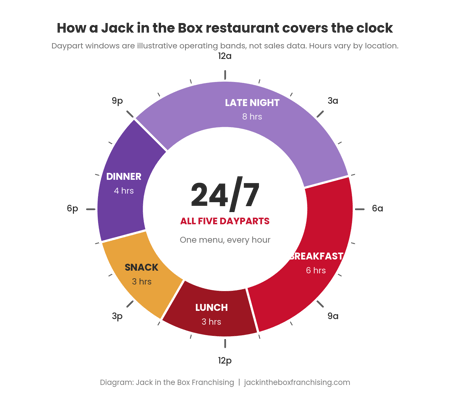
The demand signal behind this is stronger than most operators expect.
Circana's analysis of US eating and drinking occasions found that meal and snack occasions increasingly overlap, with 462 snacking occasions a year now landing inside traditional mealtimes against 789 between them, and Technomic putting the share of consumers who replace a full meal with a snack at 51%. Looking further out, Circana projects delivery growth across all dayparts through 2028, with beverage-only visits rising 2.3%.
Every one of those occasions is already on our menu. A guest who wants Tiny Tacos at 3 p.m., a shake at 10 p.m., or a breakfast burrito at 1 a.m. gets the full menu, with no changeover, no reduced late-night board, and no second kitchen setup for the operator to staff and manage. Five dayparts running off one menu is the practical version of that: the week is not resting on a single meal window.

What support does Jack in the Box provide its franchisees?
Support is organized into five functions, each with a team a franchisee works with directly rather than through a general help line: training, real estate, construction, marketing, and supply chain.
Training Support
Every franchisee completes a 10-to-14-week training program built from computer-based coursework and on-the-job hours in a live restaurant. It covers the point-of-sale system, ordering and inventory tracking, marketing and advertising, information technology, and setting growth goals. Detail is on our training and support page, and our food safety and quality control standards sit alongside it.

Real Estate Support
Our real estate team reviews trade areas and specific sites with you, and runs planning software that layers demographics, competitive sales data, and mobile movement data. You also get established broker relationships, sample leases, and sample purchase documents. Site criteria are published on our site requirements page.

Construction Support
Once a site is under control, a regionally based construction manager works the build with you: site layout, architect selection, zoning, permitting, general contracting, bid review, décor, and signage. Prototype plans and our vendor network for FF&E, millwork, and small wares come with it. See the current store design and prototypes.

Marketing Support
Brand advertising runs omnichannel at the system level. At the local level, franchisees get custom marketing plans, local initiatives, an interactive marketing site, digital, sponsorships, and the customer loyalty app. Social media accounts are managed by corporate under the franchise agreement, which means franchisees are not building or policing brand channels on their own time.

Supply Chain Support
Product is sourced through our supply chain purchasing team, with McLane handling regional distribution. Pricing and vendor structure are disclosed in the FDD.
Reasons to Invest
At Jack in the Box, we’ve noticed there’s a wide range of reasons franchisees decide to invest in a burger franchise. Below, you'll find a few of the most common reasons to own a Jack in the Box Franchise.
Drive-Thru Convenience
Roughly 90% of our 500M annual guests choose drive-thru or take-out.
All Five Dayparts
Our menu offers breakfast, lunch, dinner, snacks, and late-night.
Prime Markets Available
Access to 3,750 potential locations in new and existing U.S. markets.
Digital Guest Experience
Build a following with our online ordering and customer loyalty app.
Multi-Unit Foundation
At Jack in the Box, our average franchisee owns more than 15 locations.
Is Jack in the Box built for multi-unit operators?
Yes, and that shapes almost every conversation our development team has. Most of our franchisees are multi-unit operators, and development agreements are written around building a portfolio of restaurants rather than a single store.
The detail I find most telling is who these operators are. Roughly 75% of Jack in the Box franchisees started inside a restaurant, working in the kitchen, serving guests, or managing operations before they ever signed an agreement. We also have second and third generation franchisees running restaurants their families opened. That is a system where operators came up through the operation, which changes the tenor of a franchisee advisory conversation considerably.
If you want it in their words instead of mine, read the franchisee testimonials.
Where can I open a Jack in the Box franchise right now?
Availability is published on our Available Markets map, sorted into three tiers. The map is the current source of truth and it changes as development agreements are signed, so check it rather than an older article.
| Tier | What it means |
|---|---|
| Target Growth Markets | Actively awarding territory. Our development team wants these built. |
| Limited Opportunities Available | Open, but narrower. Specific trade areas or DMAs only. |
| Not Currently Available | Not being awarded at this time. |
State-level pages with market data, trade areas, and open metros are published for Colorado, Florida, North Carolina, Illinois, Tennessee, Michigan, South Carolina and Indiana.
Traditional freestanding restaurants are not the only format. We also develop convenience stores and travel plazas and work with hotel operators, plus stadiums, airports, and college campuses.
What else do prospective Jack in the Box franchisees ask?
No. Jack in the Box does not provide financing directly to franchisees. We do maintain established relationships with SBA lenders and other financing sources, and we allow franchisees to bring in business partners to help meet our investment requirements.
Franchisees are required to purchase or lease the property where their restaurants are located. Our real estate team helps review trade areas and specific sites, and provides broker relationships, sample leases, and sample purchase documents.
Yes. Our flexible design adapts to non-traditional sites including stadiums, airports, college campuses, convenience stores, travel plazas, and hotels. Site criteria and prototype options vary by format.
Franchisee training runs 10 to 14 weeks. It combines computer-based coursework with on-the-job hours in a live restaurant, covering the point-of-sale system, ordering and inventory tracking, marketing and advertising, information technology, and setting growth goals.
We look for candidates with multi-unit operating experience and the financial qualifications outlined on our ideal candidate page. Most of our current franchisees came up through restaurant operations before signing a development agreement.
No. All Jack in the Box social media accounts are managed by corporate. Under the franchise agreement, franchisees are not permitted to establish their own social media pages or websites for their restaurants.